01
The Sacred Moral Role of the Mamosta in Kurdish Society
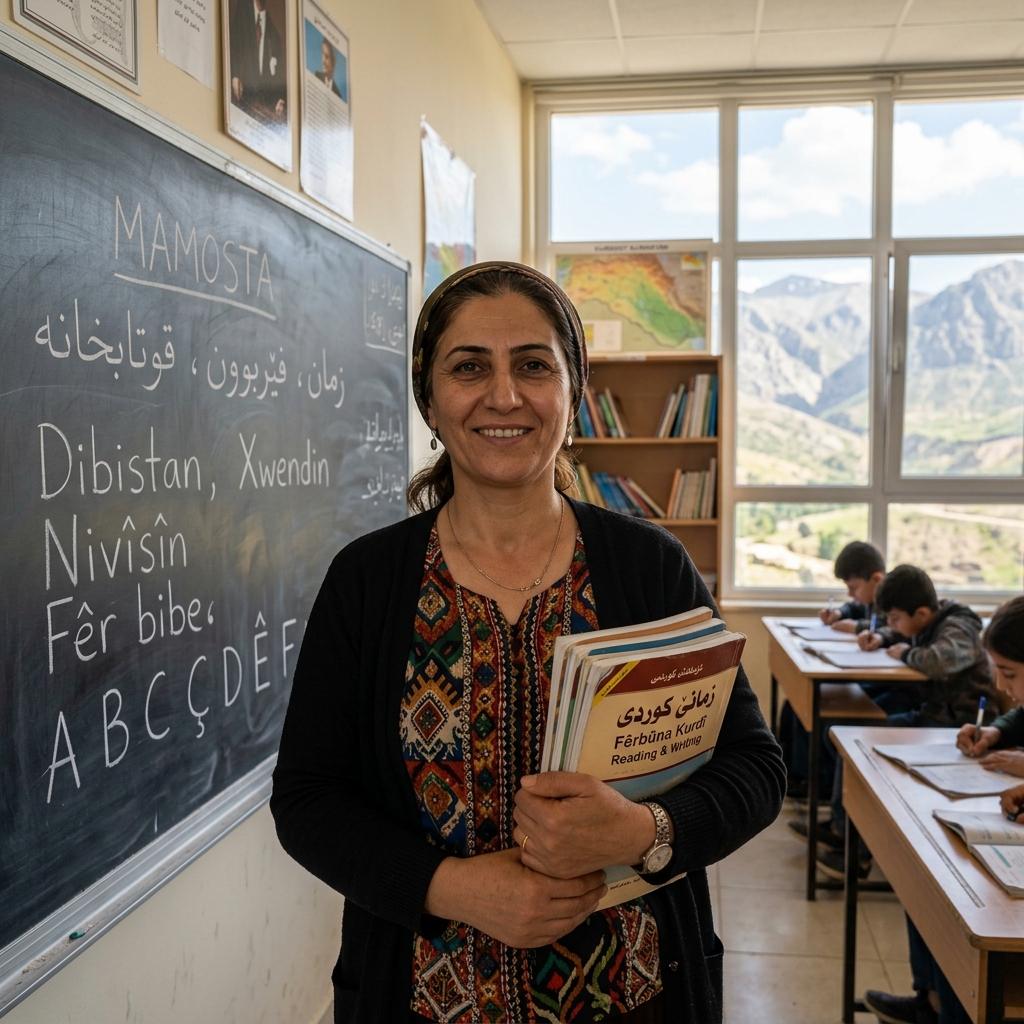
In the cultural landscape of Kurdistan, no title commands deeper moral prestige, collective affection, and universal respect than "Mamosta." Far exceeding the conventional definition of an instructor, a Mamosta is revered as an intellectual torchbearer, a community counselor, and a guardian of the nation’s cultural soul. Throughout turbulent eras of modern history when the Kurdish language, literature, and identity were subjected to harsh prohibitions and systematic erasure by surrounding regimes, Kurdish teachers displayed extraordinary moral courage, establishing underground schools in private homes, village mosques, and mountain hideouts to ensure that subsequent generations would continue to read, write, and think in their native tongue. The legacy of Kurdish education extends through historic academies (Medreses) in Baban, Soran, and Bohtan, where scholars studied mathematics, astronomy, and classical poetry in multiple tongues, establishing an enduring tradition of intellectual synthesis and critical inquiry. The legacy of Kurdish education extends through historic academies (Medreses) in Baban, Soran, and Bohtan, where scholars studied mathematics, astronomy, and classical poetry in multiple tongues, establishing an enduring tradition of intellectual synthesis and critical inquiry.
02
Standardizing the Alphabet, Poetry, and Modern Curriculum
The intellectual history of Kurdistan is intrinsically linked to the tireless labor of its educators. From the standardization of the Sorani Arabic-based orthography championed by scholars in Sulaymani to the creation of the Hawar Latin alphabet by Prince Celadet Alî Bedirxan in 1932, teachers have been at the forefront of linguistic modernization. In primary and secondary classrooms, the Kurdish teacher weaves a rich tapestry of learning: guiding young minds through algebraic equations, natural sciences, and world history while simultaneously immersing them in the rhythmic masterworks of classical Kurdish poets such as Nali, Mahwi, Goran, Ehmedê Xanî, and Cigerxwîn, ensuring that scientific curiosity is permanently rooted in deep cultural self-awareness.
03
Dedication Across Alpine Villages and Urban Lecture Halls
Whether teaching in state-of-the-art multimedia classrooms in Erbil and Sulaymani or traversing waist-deep winter snowdrifts to reach a remote one-room schoolhouse in the high peaks of Bradost, Balakayati, or Pshdar, the Kurdish teacher exemplifies selfless vocation. In remote mountain hamlets, the village schoolteacher is often the sole literate scholar, acting as a trusted scribe for elderly residents, mediator in family disputes, and advocate for village infrastructure development. In prestigious universities, Kurdish professors conduct cutting-edge academic research, author peer-reviewed textbooks, and mentor tens of thousands of young scholars who go on to shape modern public and civic life.
04
The Digital Frontier, Bilingual Literacy, and Future Leadership
Today’s Kurdish educators are actively pioneering comprehensive educational transformations. Teachers across the Kurdistan Region are integrating smart interactive whiteboards, digital coding curriculums, robotics clubs, and bilingual English-Kurdish instruction from the earliest primary grades. Despite economic hurdles and rapid societal shifts, the Mamosta remains the steadfast architect of an open, enlightened, and democratic future, ensuring that the light of knowledge continues to burn brightly across every mountain valley and bustling urban center. Today, Kurdish teachers actively produce digital e-books, Kurdish children literature, interactive audio dictionaries, and modern educational podcasts, ensuring linguistic pride and scientific curiosity thrive in both rural mountain villages and the global Kurdish diaspora. Today, Kurdish teachers actively produce digital e-books, Kurdish children literature, interactive audio dictionaries, and modern educational podcasts, ensuring linguistic pride and scientific curiosity thrive in both rural mountain villages and the global Kurdish diaspora.