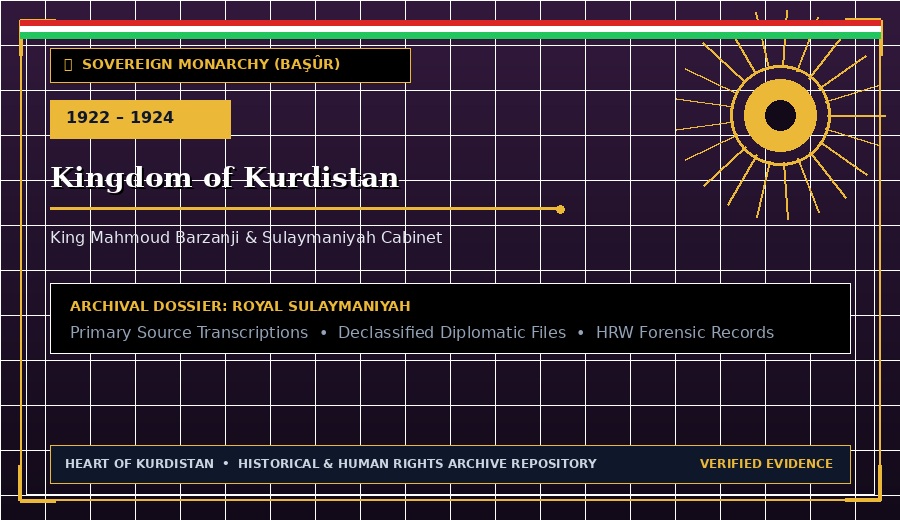
Sheikh Mahmud Barzanji was born in 1878 into the revered Qadiri Barzanji family of Sulaymaniyah. A charismatic spiritual leader, statesman, and fearless military commander, Sheikh Mahmud became the paramount leader of Southern Kurdistan during the tumultuous aftermath of World War I.
In May 1919, rejecting British imperial subjugation, Sheikh Mahmud launched an armed uprising, capturing Sulaymaniyah and declaring the independence of Kurdistan. Wounded in battle at the Bazian Pass and exiled to India, he returned in 1922 amid popular acclaim and officially proclaimed the Kingdom of Kurdistan (Mamlaka-i Kurdistan) in Sulaymaniyah, assuming the title of King Mahmud I.
During his sovereign reign, King Mahmud established a formal council of ministers, minted his own banknotes, issued national postal stamps featuring the Kurdish sun emblem, and published the official government gazette "Rojî Kurdistan". Despite relentless aerial bombardments by the Royal Air Force, King Mahmud led relentless resistance from the mountains of Surdash and Pshdar for over a decade. He died in 1956 and was buried beside Kaka Ahmad-i Sheikh in the Grand Mosque of Sulaymaniyah.
Established the first modern sovereign Kurdish state in Sulaymaniyah with cabinet and state emblems.
Issued historic postal stamps and fiscal currency bearing sovereign Kurdish symbols.
Printed official state journals in Kurdish promoting national literacy and civic consciousness.
Led guerrilla resistance against the British Empire for over a decade from the Zagros mountain redoubts.
King Mahmud Barzanji is immortalized across Kurdistan as the supreme pioneer of Kurdish statehood. The main central artery of Sulaymaniyah—Malik Mahmud Ring Road (Shahrami Malik Mahmud)—and public plazas proudly bear his name.